

Somalia Between Ankara and Abu Dhabi: A Fight for Influence Tears at a Fragile Country as Doha Stands by Its Unity
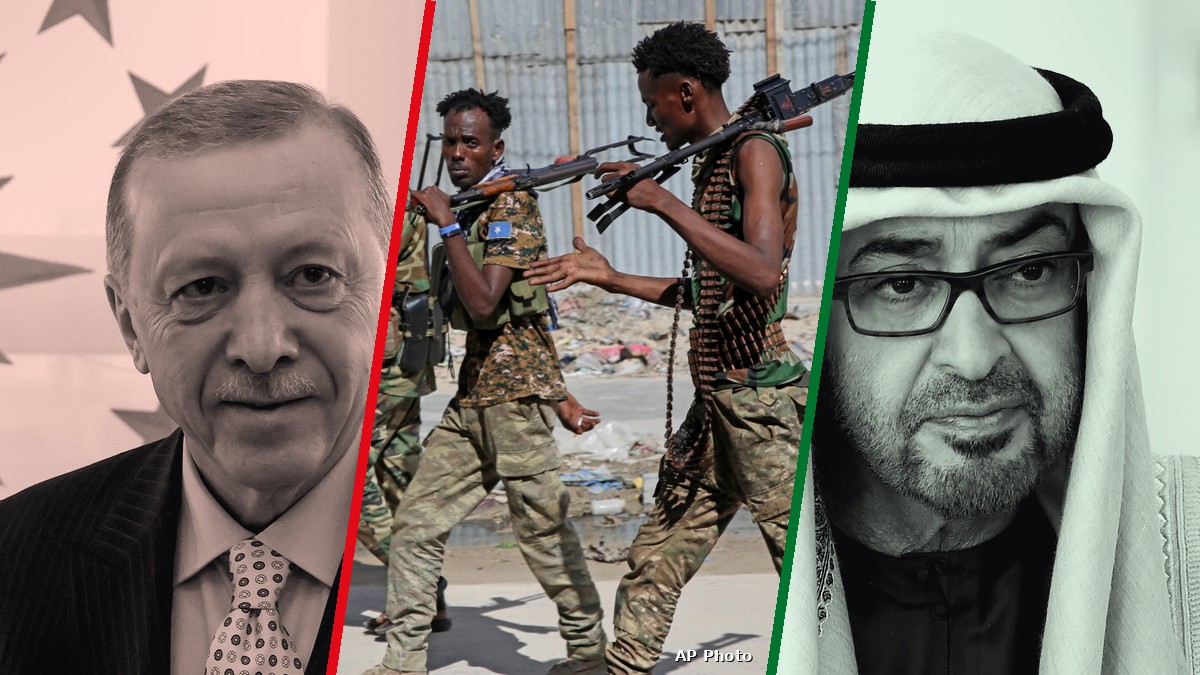
As 5.4 million Somalis face hunger, two regional powers are racing for Somalia's ports, airfields and offshore wealth. Turkey stands behind the federal government in Mogadishu. The United Arab Emirates deals directly with regional administrations in the north and the far south that do not accept the capital's authority. Between them, al-Shabaab, the al-Qaeda-linked insurgency, holds about 30 percent of the country, according to a November 2025 estimate by the Africa Center for Strategic Studies.
Qatar alone has taken another road: no military base, no port and no oil concession, only a fixed position that Somalia is one country and that its disputes are for Somalis to settle.
Why Somalia matters to the Gulf
Somalia has the longest coastline in mainland Africa, running along the Gulf of Aden opposite Yemen and then down the Indian Ocean, and it overlooks the sea lane into the Bab al-Mandab strait that Gulf oil and gas tankers use on their way to Europe. Somalia is a member of the Arab League, and its break-up would open the shore facing the Arabian Peninsula to powers from outside the region. Israel moved first in December 2025, recognising the breakaway region of Somaliland, a step Doha firmly rejected.
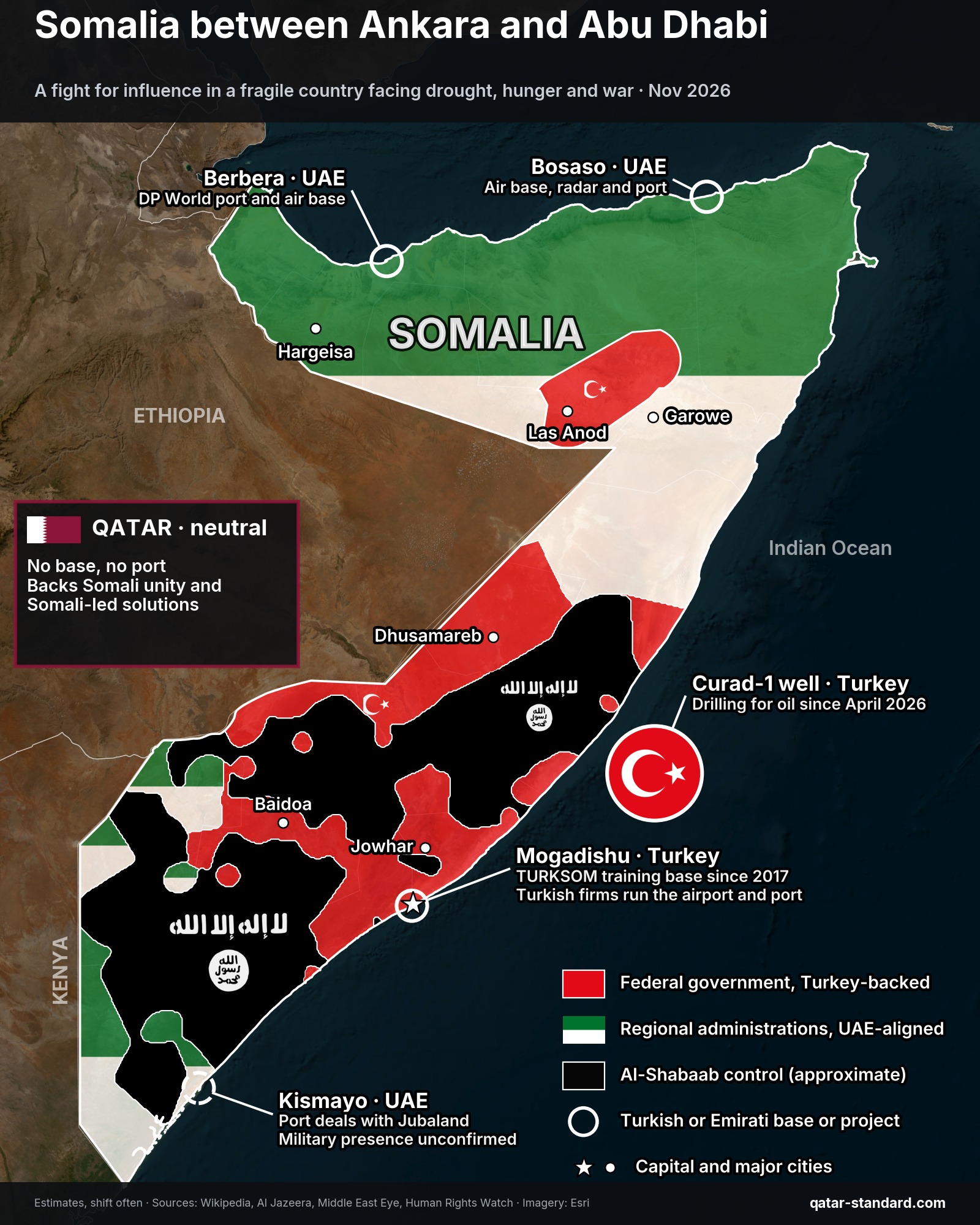
The map shows how the country divides between the two camps. It is a map of alignment, not occupation: neither Ankara nor Abu Dhabi governs Somali territory, and the al-Shabaab zone is an estimate that shifts often. But it shows that each outside power has picked a Somali side to back, and that the line between them now runs through a single country.
Turkey: oil, airspace and a president past his term
Turkey is the federal government's main military and commercial partner. Turkish companies run Mogadishu's port and airport, Turkish forces train the Somali army at a base in the capital, and Ankara deployed three F-16 fighter jets there on 28 January 2026, according to Middle East Eye. It is also building a launch and missile-test site near Warsheikh, about 70 km north of Mogadishu, according to Le Monde.
The terms draw criticism inside Somalia. A hydrocarbons agreement signed in July 2024 gives Turkey's state oil company exclusive rights to three offshore blocks. According to the text obtained by Nordic Monitor and reported by Garowe Online, the company may take up to 90 percent of annual output to recover its costs, Somalia's share is capped at 5 percent until then, no signature bonus is paid, and disputes go to arbitration in Istanbul. Somali lawmakers said they voted for the deal without seeing the text. A February 2024 defence pact reportedly gives Ankara 30 percent of revenue from Somalia's exclusive economic zone in return for rebuilding its navy. President Hassan Sheikh Mohamud calls the oil deal "mutually beneficial" and says Turkey was the only country willing to invest.
Ankara's partner faces its own crisis of legitimacy. On 5 November, Somalia's Supreme Court ruled that Mohamud's term ended on 15 May 2026 and that the extension parliament gave him was unconstitutional. Federal troops entered Baidoa in March after a dispute with the South West State administration, and fighting there has not stopped.
The UAE: bases and ports, bypassing Mogadishu
The UAE has gone around the federal government altogether. A New York Times visual investigation published on 20 November found that Abu Dhabi has turned the airports at Berbera, in the breakaway region of Somaliland, and Bosaso, in Puntland, into military bases, and reported cargo flights and vehicles moving through Berbera toward the wars in Sudan and Ethiopia. DP World has run Berbera port since 2016.
In a speech on 17 November, Mohamud said the UAE signed port deals for Berbera, Bosaso and Kismayo with regional administrations rather than the state, and accused it of arming forces outside the national chain of command. "A brother does not burn your house, does not buy your property without your knowledge, and does not divide your family," he said. Mogadishu suspended its agreements with Abu Dhabi in January and on 19 November gave the UAE ambassador 72 hours to leave. The UAE has rejected the accusations.
Somalis pay the price
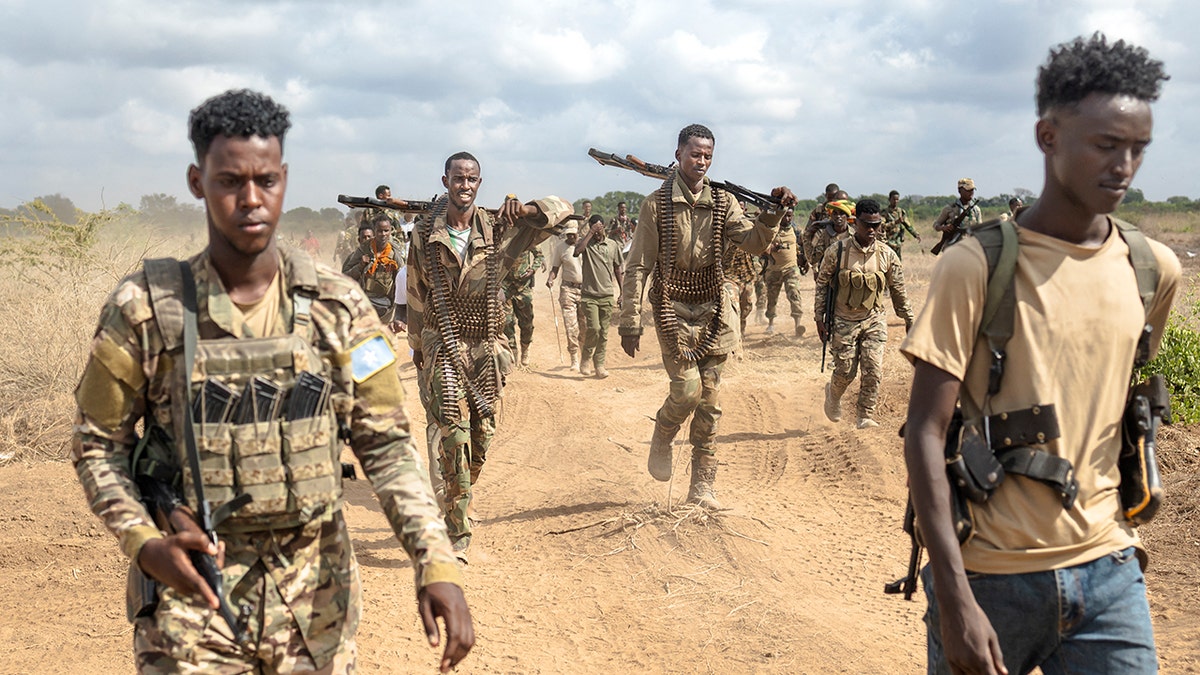
None of this money or hardware is aimed at the crisis most Somalis are living through. The latest IPC food-security analysis, published on 23 September, projects 5.4 million people, 28 percent of the population analysed, in crisis-level hunger or worse between October and December, and warns of a risk of famine for the second analysis in a row. It counts 1.92 million children under five as acutely malnourished, 433,000 of them severely.
Northern regions have had four failed rainy seasons in a row, and forecasts warn of floods in the south this season. UNICEF estimates 3.5 million Somalis are displaced inside the country and more than three million children are out of school. The UN's 2026 humanitarian plan says aid operations have been cut by 70 percent and more than 600,000 people have lost food and cash support. On 2 November Uganda, the largest contributor to the African Union force fighting al-Shabaab, said it will withdraw all its troops.
Doha: one Somalia, settled by Somalis
Qatar has stayed out of the race. It has no military base in Somalia, runs none of its ports and holds none of its oil concessions. Its relationship is with the Somali state and its institutions, including a defence cooperation and training agreement signed in Doha in January, and its position has not changed: Somalia is one country, and its disputes are for Somalis to settle.
Doha has said so when it carried a cost. When Israel recognised Somaliland, Qatar's foreign ministry called it a flagrant violation of international law and of the territorial integrity of "the sisterly Federal Republic of Somalia", rejected any attempt to impose parallel entities, and called for an emergency Arab summit. In a February call with Mohamud, His Highness the Amir Sheikh Tamim bin Hamad Al Thani reaffirmed Qatar's support for Somalia's legitimate state institutions and its territorial unity. Prime Minister and Minister of Foreign Affairs Sheikh Mohammed bin Abdulrahman bin Jassim Al Thani repeated that position when he received Somali Prime Minister Hamza Abdi Barre in Doha on 30 August.
A record of reconciliation
This is not the first time Doha has stood by Somalia's unity, and it has done the practical work of talking to every side. In May 2021, with Somalia stuck in a delayed-election crisis and cut off from Kenya, Qatari envoy Mutlaq bin Majed Al-Qahtani met the Somali prime minister and opposition leaders in Mogadishu, travelled to Hargeisa to meet the region's leadership, and carried a message from the Amir to Nairobi. On 6 May Mogadishu announced it was restoring ties with Kenya after a five-month break and said the result came "in large part" through the Amir's efforts. "The State of Qatar will always strive for good relations and remain a peace maker," Sheikh Tamim wrote at the time.
That record runs across the region. Qatar brokered the Doha Document for Peace in Darfur in 2011, mediated the border dispute between Djibouti and Eritrea, and in 2025 hosted talks between the Democratic Republic of Congo and the M23 rebels.
Somalia looks for a mediator
Somalia now needs exactly that kind of broker. The Supreme Court has given the rival camps 30 days to agree an election framework. On 20 and 21 November the opposition refused direct talks with the presidency and asked for international mediation, without naming a mediator. Turkey is too close to the presidency to be accepted as neutral, and the UAE has just had its ambassador expelled. Qatar is the one outside party with open channels to Mogadishu, a history of talking to its opponents, and no interests on the ground to protect. No formal Qatari mediation has been announced.
Humanitarian, not military
Qatar's presence on the ground is humanitarian and developmental. Qatar Charity carried out 233 projects in Somalia in 2025, reaching more than 267,000 people, and in July signed an agreement with Somalia's health ministry for 39 health projects worth $1.46 million, covering malnutrition treatment, heart surgery for children and cataract operations. In August it gave cash aid to 1,530 displaced families on the outskirts of Mogadishu. In December 2025 the two countries held the first meeting of their joint committee and signed agreements on agriculture, customs, culture and youth.
That is the difference. Military bases and oil and port concessions give outside powers a stake in keeping the Somali side that signed with them strong against the others. Somalis' disputes over the constitution, elections and the powers of the regions can only be settled by Somalis themselves. Doha's case is that outside support should bring Somalis together, not buy one side of them.
النسخة العربية
الصومال بين أنقرة وأبوظبي: صراع نفوذ يمزّق بلداً هشاً.. والدوحة تتمسك بوحدته
فيما يواجه 5.4 مليون صومالي خطر الجوع، تتسابق قوتان إقليميتان على موانئ الصومال ومطاراته وثرواته البحرية. تركيا تقف خلف الحكومة الفيدرالية في مقديشو، والإمارات تتعامل مباشرة مع إدارات إقليمية في الشمال وأقصى الجنوب لا تعترف بسلطة العاصمة. وبين الطرفين تتمدد حركة الشباب المرتبطة بتنظيم القاعدة، التي قدّر مركز أفريقيا للدراسات الاستراتيجية في نوفمبر 2025 أنها تسيطر على نحو 30 في المئة من أراضي البلاد.
وحدها قطر اختارت طريقاً آخر: لا قاعدة عسكرية، ولا ميناء، ولا امتياز نفطي، بل موقف ثابت بأن الصومال بلد واحد، وأن خلافاته شأن يحسمه أبناؤه.
لماذا يعني الصومال الخليج
Source tweet
As 5.4 million Somalis face hunger, Turkey and the UAE split Somalia between them: Ankara with the federal government and its oil rights, Abu Dhabi with the regions and bases at Berbera and Bosaso. Qatar holds no base or port and backs one Somalia.
More Stories
 Gulf
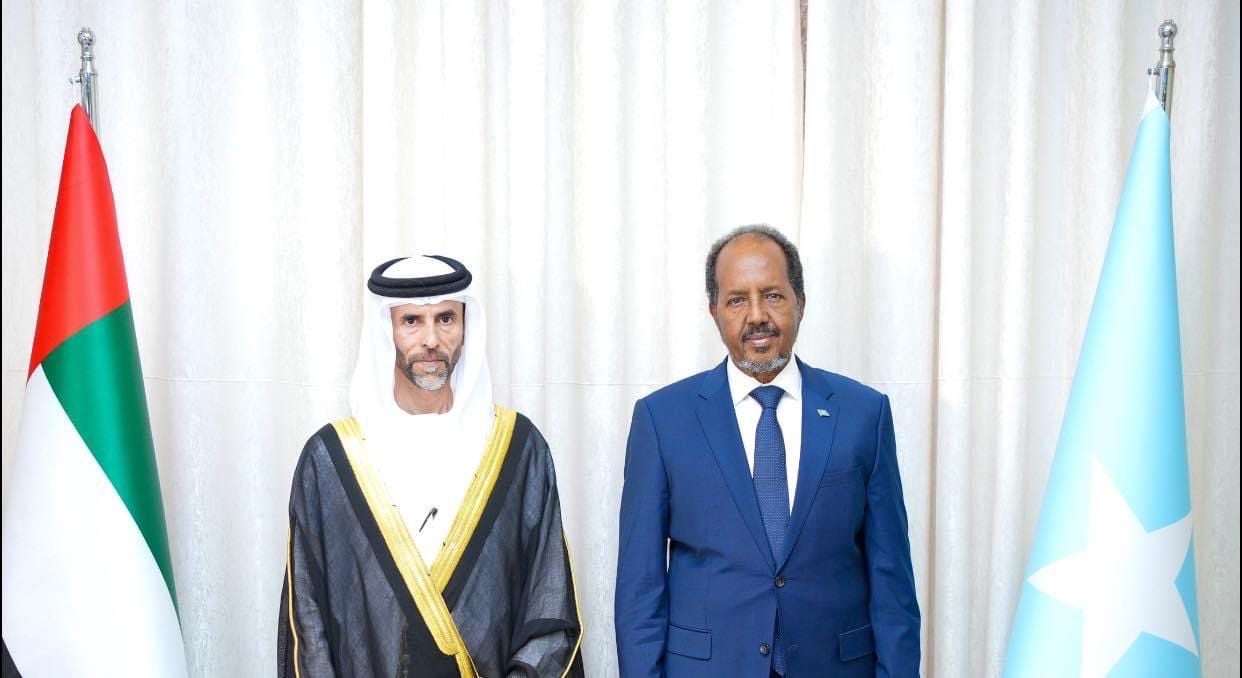
UAE rejects Somalia's interference claims after Mogadishu expels Emirati envoy
 Africa
UAE Government Sources: Envoy Told Somalia's President 'Eat, Donkey, and Thank God' in Call Before Angry Speech
 Africa
Embattled Somalia President Blames the UAE as Mogadishu Loses Its Grip
 Africa
Somalia's Supreme Court rules president's term expired, orders elections within 90 days
 Africa